
A committee of MPs has found "compelling evidence" of a failure of financial management within the NHS, it reveals in a critical report published today.
The Labour-controlled health select committee says ministers and hospital managers failed to estimate the effects of an "extraordinary growth in staff costs arising from pay rises and a large increase in staff numbers", and the NHS responded to its ballooning deficits by slashing the amount spent on training. "This is unacceptable," say the MPs.
The report comes as William Moyes, regulator of foundation hospitals, warned that financial instability was spreading from the NHS mainstream to affect the elite institutions under his supervision. He said foundation trusts made a £36m surplus over the first six months of the financial year, but many had become mired in disputes with cash-strapped primary care trusts which were withholding payment for patients already treated.
The select committee says government estimates of the cost of new contracts for health workers were "hopelessly unrealistic", targets to reduce patients' waiting times were imposed without regard to cost, and the NHS was trying to balance the books this year by taking money from "soft targets", including medical training and mental health.
The committee concludes: "In recent years the NHS veered from one priority to the next as the political focus has changed. It has concentrated on meeting targets with too little concern for finance."
The health secretary, Patricia Hewitt, blamed the problem on 20% of NHS trusts that were responsible for 90% of the deficits. "We are working closely with them to put this right," she added
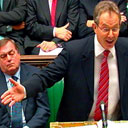
The report's findings were seized on by the Tory leader, David Cameron, who challenged Tony Blair over accusations of "poor central management" of the NHS.
"Will you accept that this poor central management and the financial crisis in the NHS is harming patient care. Yes or no?" Mr Cameron asked. The prime minister dismissed the claim and retorted that patient care was improving due both to "massive" investment and the implementation of his reforms.
"That is perfectly obvious from the publication of the results this morning, but also the fact that when we came to office there were literally hundreds of thousands of people that used to wait 12 months, sometimes 18 months for their operation. We are now on course for an 18-week, door-to-door: that is in and out-patient lists combined." But Mr Cameron shot back: "We've got accident and emergency departments threatened, we've got maternity units under review, community hospitals closing. You must be the only person in this country who thinks that patient care isn't suffering."
Mr Blair said that A and E departments were "transformed" under Labour, and hailed progress in areas such as cardiac care and the largest hospital building programme ever. "The fact is that the NHS is getting better," he told MPs today.
Also responding to today's committee report, NHS managers made a robust defence of their role in the NHS.
Dr Gill Morgan, chief executive of the NHS Confederation, said that the panel of MPs had taken the "easy route" of blaming NHS managers for the NHS' financial woes.
"We need to look at the whole picture and not make NHS managers the scapegoat for the financial problems facing some trusts," she said.
"As the select committee recognises, there are a number of reasons for NHS deficits. Short-term pressures such as national targets and workforce reforms have put enormous strain on the service. And longer-term issues such as unresolved structural problems have been exposed by changes to accountancy rules."
