
It sounds curious at first. Why would an international medical charity, renowned for its work in developing countries, want to set up a clinic in London? After all, doesn't the NHS proudly boast that it is recognised as one of the best health services in the world?
This may be true, but in the cultural, racial and social mix of east London, people are slipping through the net. Refugees, immigrants, sex workers: Médecins du Monde (MdM) is convinced that too many people are not getting the care they need.
There was a flurry of headlines when the French charity announced its intentions late last year. It was seen by some as a controversial, unnecessary move, at a time when the NHS was so strong. But the charity had spent years researching the needs of vulnerable groups in Britain and found that, in particular, homeless people, women involved in prostitution and many migrants found it hard to gain access to health services.
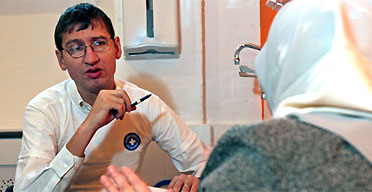
The charity's clinic, in bustling, multi-ethnic Bethnal Green, opened last month. Staffed by volunteer doctors and nurses, it aims to reach the hidden and vulnerable communities of east London.
One volunteer, Liz Annun, who has been a nurse for 34 years, said people come to the MdM clinics with the same sorts of problems you would find in any general surgery, such as back pain or skin problems, or more chronic conditions. Medical staff can give patients advice, reassurance or a prescription, bridging a gap while they are linked with mainstream medical services.
Ms Annun said the need for the charity's work became obvious when she started working in an NHS walk-in centre a year ago.
"It seems from the walk-in centre that people have trouble accessing the NHS, for example because they don't have their name on a [utilities] bill to help register," she says. "At the walk-in centre, we can give advice but can't follow up and go with them to a GP, whereas at MdM we're are able to offer extra help. It's very satisfying."
Held at the migrant help charity Praxis, the twice-weekly sessions are open to all-comers. At the first clinic, visitors included a homeless man, an English couple and a Lithuanian woman who brought her daughter along to translate.
Patients drift in through the course of each four-hour clinic, led through Praxis's labyrinthine corridors by health support workers who ask them basic health questions to establish whether they should see the volunteer nurse or a GP.
For Dan Campion, a GP and MdM volunteer, the new clinic has been a revelation. He worked in wealthy Cheshire before becoming a London locum and was surprised to see, at his first clinic, two patients with chronic health problems who had been "obtaining medication by informal means".
One was homeless and the other in domestic service. These are some of the hidden people the charity is working hard to reach.
At the clinic, Dr Campion, who worked in hospital A&E before qualifying as a GP, helped patients register with a doctor and explained how the health service works.
"It's been a real eye-opener for me," he says. "I knew MdM had similar operations across Europe and suspected there was a need for organisations ... to promote access to healthcare, but I hadn't met these problems in my general practice.
"MdM has identified a need. I think the NHS is under pressure and it's good to have our service as a complementary [one] - but we are not aiming to replace it."
The charity's belief in the need for the outreach services it offers is based on a strong record working in countries across Europe. Although it mainly provides emergency relief and long-term care in the developing world, in the 1980s volunteers returning to France noticed that some people in their own country found it hard to obtain healthcare. Twenty years on, MdM has 100 clinics across France, and others in European countries including Belgium, Spain and Sweden.
Despite being sceptical about the need for the charity's intervention in the first place, the local primary care trust's director of public health now endorses the clinic. A solid working relationship is being established as MdM refers patients and liaises with NHS workers with a common cause, such as discussing projects to tackle HIV.
The charity's UK director, Karen McColl, says she and other MdM officials regularly met NHS groups when setting up the project, and Tower Hamlets primary care trust even provided money to redevelop the first clinic.
MdM has committed £35,000 so far to Project: London, raised from grants and private donations. The first clinic has been running for a month and demand is growing, although often the four volunteers at each session outnumber the patients.
The charity plans to open two more clinics this year, in partnership with local charities helping homeless people and women involved in prostitution. "Those clinics will be for people who find it hard to access the NHS because, for example, they work nights and so find it difficult to make day appointments or to book days in advance," Ms McColl says.
Concerning the controversy surrounding Project: London, she is sanguine and stresses the charity is not trying to step on anyone's toes. "The NHS has been doing outreach work for a long time, and we are just filling in the gaps," she says.
"We are working in some of the poorest countries in the world and the UK certainly does not fit that [profile]: we are not trying to draw comparisons between the East End and the third world. But there are people here who fall through the gaps and they need help," she says.
